

No-Refund, No-Return Policies, Online Shopping and Consumer Rights Under Ghanaian Law.
Introduction
The rise of online commerce in Ghana has transformed the retail landscape. Thousands of consumers now buy goods on Instagram, Facebook, TikTok, WhatsApp, and dedicated e-commerce platforms. Yet one of the most common complaints is that the delivered product does not match the advertised product. Retailers often respond with a familiar refrain: “No Refund, No Return.” Many buyers assume such notices automatically deprive them of legal remedies. The position under Ghanaian law is far more nuanced. This piece examines whether such policies are enforceable under Ghanaian law, using the Ninja blender scenario as a practical case study in light of the Sale of Goods Act, 1962 (Act 137) and the recent Supreme Court decision in C.A. Limited v Anointed Star Construction & Trading Ltd & Anor [Civil Appeal No. J4/03/2022 (SC, 3rd June 2026)].
The Blender Scenario
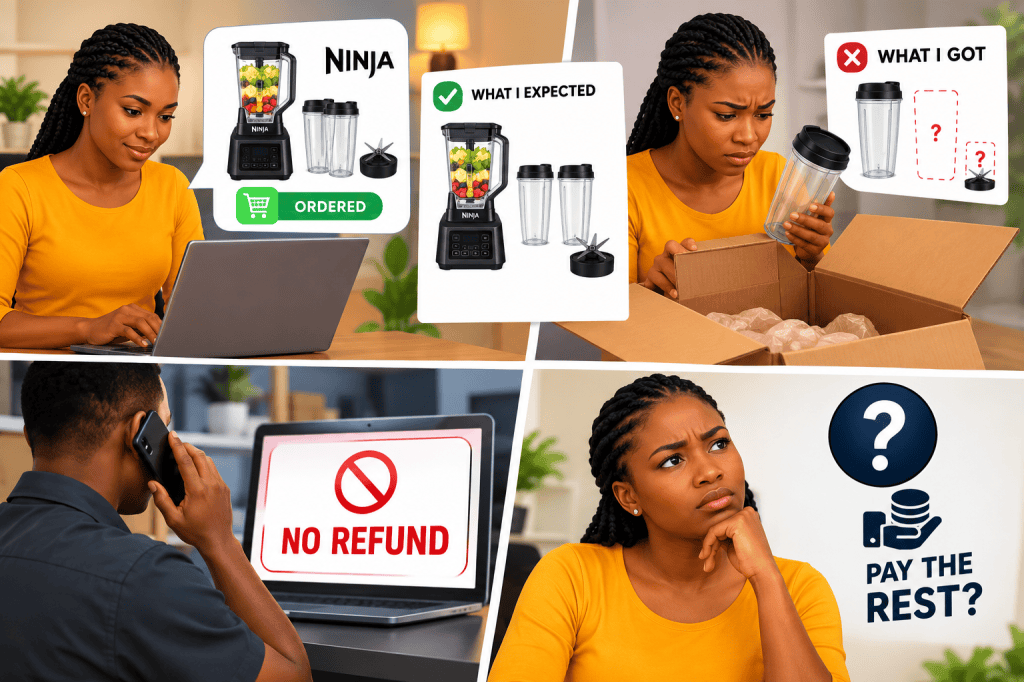
A purchaser ordered a Ninja Professional Plus Kitchen System from an online vendor. The packaging and product description indicated that the packaged included two sigle-serve cups and a pro extractor blade assembly. Upon opening the product, the buyer found that one smoothie cup and the blade assemnly were missing. The seller refused to accept a return or issue a refund. The buyer had paid 70 per cent of the purchase price and wondered whether she was still obliged to pay the remaining balance.
The Legal Framework
The governing legislation is the Sale of Goods Act, 1962 (Act 137). The Act regulates contracts for the sale of goods, in which ownership is transferred for a price. It codifies the rights and obligations of sellers and buyers and provides remedies for breach of contract by either party.
The case of C.A. Limited v Anointed Star Construction & Trading Ltd & Anor (supra) arose from a commercial credit transaction involving the supply of building materials. The Supreme Court used the appeal to provide an extensive exposition of the law governing the sale of goods in Ghana under the Sale of Goods Act, 1962 (Act 137), particularly: seller’s fundamental obligations, implied conditions and warranties, buyer’s right to reject goods, acceptance of goods, loss of the right to reject, reasonable price, seller’s and buyer’s remedies, measure of damages. The Court ultimately reaffirmed that a buyer who receives goods, uses them, and delays in rejecting them cannot later repudiate the transaction.
What Is a Contract of Sale?
A contract of sale arises when a seller transfers, or agrees to transfer, ownership of goods to a buyer for a price. Contracts may be written, oral, or inferred from conduct. The essence of the transaction is the transfer of property in goods in exchange for a price. Sections 1,2, 3 and 6 of the Sale of Goods Act, 1962 (Act 137).
Types of Sale of Goods
The law recognises specific goods, ascertained goods, unascertained goods, future goods, cash sales, credit sales and sale-or-return transactions. Online purchases commonly involve credit elements because payment and delivery often occur at different times. In the Anointed Star Construction case (supra), the Supreme Court, per Tanko Amadu JSC, explained the classifications and their importance as follows:
“Specific goods are goods identified and agreed upon at the time the contract is made. Unascertained goods are goods defined only by description and not identified at the time of contracting. Ascertained goods are goods that, though unascertained at the outset, have become identified to the contract afterwards.”
This classification matters because, as we shall see, the content of the seller’s fundamental obligation under Section 8 differs according to whether the goods are specific or unascertained, and because the passing of property under Sections 25 and 26 depends upon ascertainment. We note, that the statutory definitions have no difficulty of classification.”
Seller Obligations
The seller must have good title, deliver the contracted goods, ensure they correspond with the description and, where applicable, with the sample, and supply goods of merchantable quality and fit for purpose where the circumstances demand. The seller must also deliver the correct quantity and any accessories forming part of the contractual package. Sections 8 to 14 of the Sale of Goods Act, 1962 (Act 137). In A. Sarpong & Co v Silver Star Auto Ltd (2014) JELR 68672, the Supreme Court held that the fundamental obligation of the seller, as stated in section 8 of the Sale of Goods Act 1962, is to deliver those goods, the specific goods of which substantially correspond to the description or sample by which those goods were sold to the buyer.
The Supreme Court had this to say about the Seller’s obligation in the Anointed Star Construction case (supra):
“The cornerstone of the seller’s position is Section 8, which is in these terms. In a sale of specific goods the fundamental obligation of the seller is to deliver those goods to the buyer; in a sale of unascertained goods, it is to deliver goods substantially corresponding to the description or sample by which they were sold; and a provision of great practical importance, any term of the contract inconsistent with or repugnant to that fundamental obligation is void to the extent of the inconsistency. Section 8(3) thus places the seller’s core obligation beyond the reach of exemption clauses: a seller cannot, by the small print of his contract, contract out of the duty to deliver what he agreed to sell. This is one of the respects in which Act 137 is more protective of the buyer than the common law was, and it should be well understood by those who draft contracts of sale.” Emphasis mine.
Thus, a Seller cannot, by contractual terms, waive or exempt himself from the fundamental obligation set out in Section 8.
Buyer Obligations
The buyer must pay the agreed price, accept goods that conform to the description or sample, and take delivery where required. However, the buyer is not obliged to accept goods that materially differ from those contracted for. Sections 21 to 24 of the Sale of Goods Act, 1962 (Act 137).
Sale by Description
The blender scenario is primarily a sale-by-description dispute. Where a buyer relies on an advertisement, product listing, packaging description or a seller’s representation, the delivered product must correspond substantially with that description. If important components described as part of the package are absent, the seller may be in breach of an implied condition of the contract. Section 11 of the Sale of Goods Act, 1962 (Act 137).
Merchantable Quality and Fitness for Purpose
Goods should be reasonably fit for the purpose for which they are sold and of merchantable quality. A blender package advertised as having particular accessories may lose value and utility if those accessories are absent. The omission may therefore affect both the description and the quality. Section 13 of the Sale of Goods Act, 1962 (Act 137).
This duty of the seller may vary depending on the circumstances of the case. For instance, in the case of A. Sarpong & Co v Silver Star Auto Ltd (2014) JELR 68672, the Supreme Court held:
“The general rule under the Ghana Sale of Goods Act 1962, distinguished from the English Sale of Goods Act 1979, is that a seller of goods in Ghana, whether new or second-hand, is liable for all defects in them. This duty is an implied condition of the contract of sale. The seller is, however, not liable for those defects which he declares or makes known to the buyer before or at the time of the contract. Again, where the buyer has examined the goods, the seller is not liable for defects, which should have been revealed by the examination. It would appear then that where the defects complained of were not declared or made known to the buyer before the contract and could not have been revealed by the buyer’s examination, if any, the seller is liable. But even so, where the seller is not a dealer in the kind of goods sold, and it is established that he did not know or could not reasonably have been aware of the defects complained of, he escapes liability.”
Remedies of the Buyer
Where goods do not conform to the contract, the buyer may reject the goods before acceptance, claim damages, demand delivery of any missing components, seek replacement, recover any money already paid, or, where appropriate, obtain specific performance. The measure of damages generally aims to place the buyer in the position they would have occupied had the contract been properly performed. See Sections 49 to 58 of the Sale of Goods Act, 1962 (Act 137).
The strongest remedy available to a buyer is to reject non-conforming goods before acceptance. In the Anointed Star Construction case (supra), the Supreme Court explained this remedy, how it can be exercised, and how it can be lost. First, on the issue of under what circumstances this remedy will be available to the Buyer, the Court stated, per Tanko Amadu JSC, as follows:
“Three points deserve emphasis. First, not every breach grounds rejection: a breach of warranty does not, and even a breach of condition will not if it is of a trivial nature. Secondly, the right to reject is the law’s strongest remedy for the buyer, for it permits him to throw the whole transaction back upon the seller; and the law therefore hedges it with conditions. Thirdly, and crucially, the right to reject is not perpetual. It may be lost.”
His Lordship went further to explain how the buyer’s right to reject may be exercised in the following words: “How it is exercised, and how it is lost, are governed by Sections 50, 51 and 52 of the Act. By Section 50, where the buyer has the right to reject and exercises it, he need not return the goods to the seller; it is enough that he intimates to the seller that he rejects them, whereupon the seller becomes entitled to have them placed at his disposal. Two features of this provision are easily overlooked and were overlooked in the present case.
The first is that a rejection presupposes communication: there must be an intimation to the seller. A decision to reject locked in the buyer’s own breast, never conveyed, is no rejection. The second is that the buyer who would reject must be able to prove that he did so, and when; the burden of establishing a valid and timely rejection lies on the buyer who asserts it.” Emphasis mine.
The buyer’s right to reject goods that do not conform to the description or sample is not perpetual, as it can be lost in certain circumstances. The most prominent is when the buyer has accepted the goods. His Lordship explained how the right is lost through acceptance and what constitutes such acceptance. In his words, he stated as follows:
“Sections 51 and 52 then mark the outer limit of the right. By Section 51, the buyer may not reject goods which he has accepted. By Section 52, the buyer is deemed to have accepted the goods in any of three events: (a) where he intimates to the seller that he accepts them; (b) where, after delivery, he does an act in relation to the goods which is inconsistent with the seller’s continued ownership such as using, consuming, reselling or otherwise dealing with them as his own; or (c) where, after a reasonable time, he retains the goods without intimating to the seller that he rejects them.
The first is acceptance by words; the second, acceptance by conduct; the third, acceptance by lapse of time. The policy is that a buyer may not keep goods, treat them as his own, and hold in reserve a right to reject them whenever it later suits him to do so.
The third mode of acceptance turns on what is a “reasonable time,” and here Section 77 is decisive: what is a reasonable time is in every case a question of fact. There is no fixed period. It depends on the nature of the goods, the circumstances of the trade, the opportunity the buyer has had to examine the goods, and the use, if any, to which he has put them.”
Thus, a buyer may be deemed to have accepted goods that do not conform to the description or sample contracted for by his words (written or oral), conduct, or lapse of time after delivery or receipt of such goods, and the right to reject them may be lost. In such circumstances, the buyer’s remedy will be to sue for damages.
Remedies of the Seller
Where a buyer wrongfully refuses to pay or accept conforming goods, the seller may sue for the price, claim damages for non-acceptance, and exercise the rights of an unpaid seller. The seller may also exercise a lien on the goods, stoppage in transit, and resale in certain circumstances. These rights protect sellers against unjustified refusals to fulfil contractual obligations. These rights are set out in Sections 34 to 48 of the Sale of Goods Act, 1962 (Act 137).
No Refund, No Return Policies
Many retailers display signs stating that goods sold are neither returnable nor refundable. Such policies may have limited effectiveness when a customer simply changes their mind after purchase. However, where the product is defective, incomplete, misdescribed, or materially different from what was promised, statutory rights under the Sale of Goods Act 1962 (Act 137) cannot ordinarily be defeated by a unilateral store policy. A seller cannot contract to deliver one thing and then rely on an internal policy when something materially different is supplied.
Misrepresentation and Online Commerce
Social media commerce has heightened the legal significance of representations made through photographs, videos, captions and chats. A seller who induces a purchase by making inaccurate statements about a product’s nature, quality, contents or accessories may face liability beyond a simple breach of contract. Screenshots and electronic communications can be important evidence. For these reasons, the law implies certain terms into contracts for the sale of goods, even if the parties do not expressly provide for them, unless there are contrary express terms. In the case of Fafape Ama Etsa Foe & Anor v Z-Auto Trade Ghana Ltd & Anor (2026) JELR 114766, the Supreme Court stated as follows:
“In Ghana, for policy reasons, some statutes mandatorily imply certain terms into certain contracts, notably the Sale of Goods Act, 1962 (Act 137). Unless there is a contrary express term in a contract for sale, Act 137 implies certain standard terms into every contract for the sale of goods. Sections 9 – 14 of Act 137 are implied into every contract for the sale of goods in Ghana. In brevity, they are summarized as follows:
Section 9 – an implied condition that the goods are in existence in the case of specific goods;
Section 10 – an implied warranty on the part of the seller that that he has the right that he has the right to sell the goods at a time when the property is to pass.
Section 11 – in a contract for sale of goods by description, an implied condition that the goods shall correspond exactly with the description.
Section 12 – in a contract for the sale of goods by sample, an implied condition that the goods shall correspond exactly with the sample.
Section 13 – an implied condition that the goods are free from defects unknown to the buyer and a further implied term that, in certain circumstances, the goods are reasonably fit for the purpose for which they are required.”
Ghanaian courts also generally uphold the principle that statutory implied terms cannot be easily excluded where doing so would constitute unfair dealing or misrepresentation.
To the Blender Dispute
If the packaging, advertising or the seller’s representations indicated that two cups and a blade assembly were included, there is a strong argument that the delivered goods did not conform to the contractual description. The buyer would therefore have legitimate grounds to insist on delivery of the missing items, seek a reduction in price, reject the goods if the breach is serious, or pursue damages. The seller’s refusal to offer any remedy merely because of a no-refund policy is legally questionable. Ghanaian courts have consistently treated contractual descriptions, quality obligations and proprietary rights seriously in sales transactions.
Should the Buyer Refuse to Pay the Remaining 30 Percent?
The answer depends on whether the supplied goods conform to the contract and whether the buyer has accepted them. If the missing accessories constitute a substantial deviation from the goods purchased, the buyer may have lawful grounds to withhold payment until the matter is resolved. Nevertheless, buyers should communicate clearly, preserve evidence and pursue remedies through legally recognised channels rather than simply ceasing communication with the seller.
Practical Lessons for Ghanaian Consumers
Always keep screenshots of online advertisements. Request invoices and receipts. Inspect goods immediately upon delivery. Report any discrepancies promptly and in writing. Preserve packaging and product literature. These steps often determine the success of any subsequent claim.
Practical Lessons for Retailers
Retailers should accurately describe products, retain records of disclosures, and avoid blanket statements implying that consumers have no rights once payment is made. Transparent disclosure and prompt complaint resolution usually cost less than litigation and reputational damage.
Conclusion
The expression “No Refund, No Return” is often treated as the final word in every dispute. Under Ghanaian law, it is not. Where goods differ from what was advertised, described or contracted for, a buyer may invoke statutory remedies under the Sale of Goods Act, 1962 (Act 137). In the Ninja blender scenario, the key question is whether the missing accessories were part of the contractual description. If so, the seller cannot avoid legal responsibility merely by pointing to a no-refund policy. Contractual obligations, statutory protections and fairness remain the governing principles. The Supreme Court case of C.A. Limited v Anointed Star Construction & Trading Ltd & Anor. [Civil Appeal No. J4/03/2022 (SC, 3rd June 2026)] serves as a useful reference for disputes relating to the sale of goods. However, as e-commerce becomes the norm, Ghana should enact a Consumer Rights Protection Act to address the growing complexities of consumer protection, especially in the sale of goods.
Disclaimer
This article is intended for general information and discussion purposes only and does not constitute legal advice. The Ninja blender scenario is used as a practical illustration of the legal issues discussed and is based on information shared with the author. The views expressed are personal to the author, and readers are encouraged to seek independent legal advice where they require guidance on a specific situation. Any references to legal principles, statutes, or court decisions are made for educational purposes only.

