
Understanding Ghana’s New Road Traffic Enforcement Regime and the Laws That Govern Every Road User
Introduction
Ghana’s roads are increasingly congested, vehicle ownership continues to rise, and road crashes remain one of the country’s most persistent public safety challenges. According to statistics published by the National Road Safety Authority, Ghana recorded 14,743 road traffic crashes, 16,714 injuries, and 2,949 fatalities in 2025, marking the highest annual road death toll in approximately thirty-five years. These figures are more than statistics. They represent lives lost, families broken, businesses disrupted, and enormous costs to the national economy.
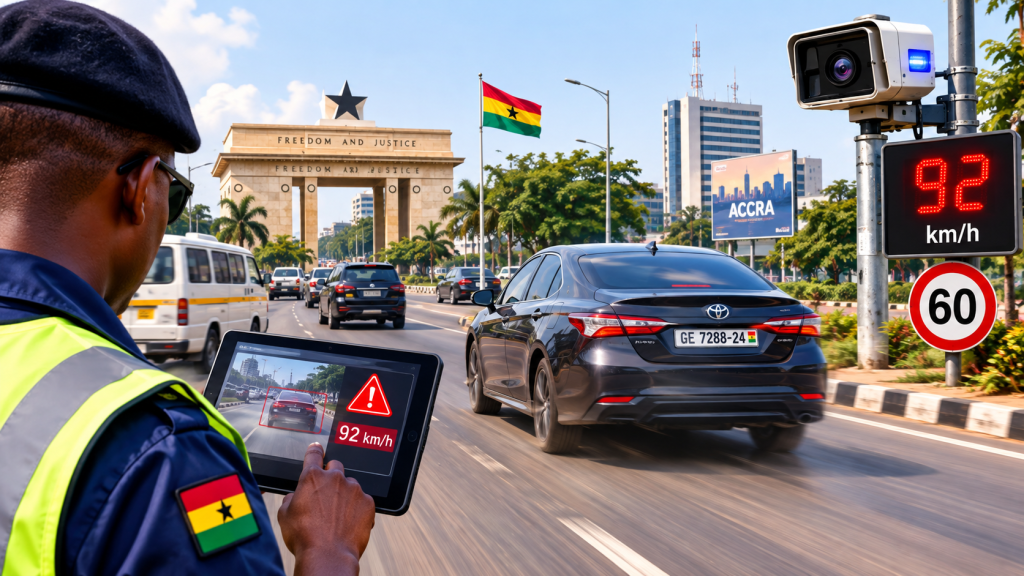
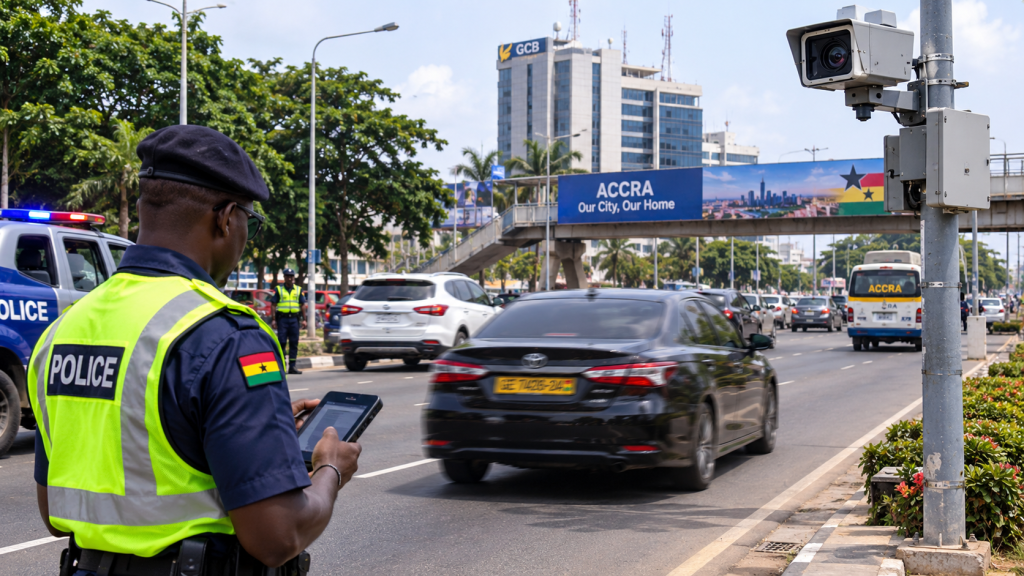
Against this backdrop, Ghana has, over the years, made significant changes to its road traffic laws; specifically, within the last year, it introduced a new technology-driven traffic enforcement regime, popularly known as TraffiTech-GH. The system utilises automated traffic enforcement devices, including cameras and related technology, to monitor road use, detect offences, and facilitate enforcement with minimal human intervention. The legal framework for this new regime is set out in the Road Traffic (Amendment) Act, 2025 (Act 1153) and the Road Traffic Regulations, 2026 (L.I.2519).
As with every major regulatory reform, the TraffiTech-GH rollout has sparked considerable debate. Some have welcomed it as a necessary step towards improving road discipline, while others have raised concerns about road conditions, inadequate signage, fairness, privacy, mistaken ticketing, and the cost of penalties.
These concerns are legitimate and warrant attention. However, we cannot wait until every road is perfect before improving compliance and enforcement. Likewise, we cannot expect improved road safety without stronger accountability.
The more pertinent question, therefore, is not whether TraffiTech-GH should exist.
The question is:
Are We TraffiTech Ready?
In my view, the answer hinges on four critical issues:
1. Transparency;
2. Education;
a. Public Education
b. Self-Education
3. Feedback, Appeals and Support Services; and
4. Compliance.
Understanding these issues requires not only an understanding of TraffiTech-GH but also of the broader legal regime governing road use in Ghana.
What Is TraffiTech-GH?
TraffiTech-GH is Ghana’s automated traffic enforcement system. In practical terms, it uses technology, cameras, sensors, electronic databases and automated processing systems to detect road traffic violations and issue sanctions in accordance with the law. Its objective is to improve compliance, reduce accidents, strengthen accountability and eliminate some of the challenges associated with solely manual enforcement.
The system marks a shift from a model in which enforcement depended almost entirely on physical interception by officers to one in which violations may be detected electronically and processed digitally.
Under Regulation 242 of the Road Traffic Regulations, 2026 (L.I.2519), the Ghana Police Service is authorised to install, deploy, and use manned and unmanned Traffic Enforcement Devices and may issue Electronic Notices of Violation based on information obtained from them.
The Regulations also prescribe:
- Automated road traffic offences;
- Electronic notices;
- Automated fines;
- Reminder notices;
- Late-payment consequences;
- Registration restrictions;
- Licence renewal restrictions;
- Vehicle impoundment in specified circumstances; and
- Prosecution procedures where liability is disputed
The Legal Framework Governing Road Use in Ghana
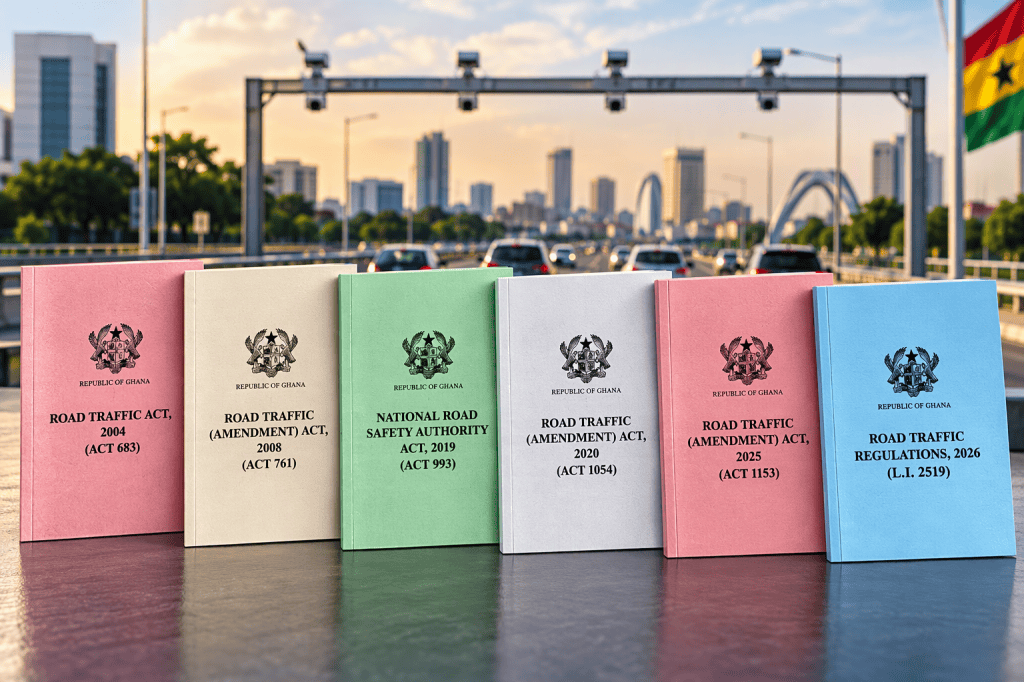
Every road user should become familiar with the principal laws governing road traffic and road safety.
These laws include:
- Road Traffic Act, 2004 (Act 683)
- Road Traffic (Amendment) Act, 2008 (Act 761)
- Road Traffic (Amendment) Act, 2020 (Act 1054)
- Road Traffic (Amendment) Act, 2025 (Act 1153)
- Road Traffic Regulations, 2026 (L.I.2519)
- National Road Safety Authority Act, 2019 (Act 993)
Together, these enactments set out the rights, responsibilities, offences, penalties and enforcement mechanisms applicable to drivers, riders, vehicle owners, pedestrians, transport operators and regulators.
Transparency
The success of TraffiTech-GH depends heavily on transparency. Automated enforcement should never be perceived as a means of ambushing motorists or generating revenue through surprise enforcement.
Road users ought to know:
- Where traffic enforcement devices are deployed;
- The types of conduct that constitute violations;
- The applicable penalties;
- The process for challenging a notice;
- The consequences of non-payment.
Similarly, roads equipped with enforcement devices should have adequate signage, clear road markings and visible traffic control devices.
Compliance is most effective when individuals understand the rules before they are penalised.
Education
Public Education
Public acceptance of any enforcement regime is directly linked to public understanding. The Ghana Police Service, Motor Traffic and Transport Department (MTTD), is doing its best to educate the public about this new regime; however, responsibility for educating road users cannot rest with a single institution. The Ministry of Transport, the Ghana Police Service MTTD, the Driver and Vehicle Licensing Authority, and the National Road Safety Authority should collaborate to ensure consistent messaging and uniform public education.
Educational campaigns should explain:
- TraffiTech-GH;
- Driver responsibilities;
- Vehicle-owner responsibilities;
- Speed limits;
- Electronic notices;
- Automated fines;
- Appeals procedures;
- Ownership transfer obligations;
- Insurance obligations.
Self-Education
Many complaints about TraffiTech-GH stem from a lack of familiarity with road traffic laws. Unfortunately, many road users rely exclusively on social media commentary rather than on the actual legislation. Every road user should take time to read and understand the governing laws.
The following summary highlights some of the most important provisions.
Key Road Laws Every Road User Should Know
| Law | Key Subject Matter |
| Road Traffic Act, 2004 (Act 683) | Driver licensing, registration, dangerous driving, general road users’ guidance, insurance, accident reporting and penalties. |
| Road Traffic (Amendment) Act, 2008 (Act 761) | Amendments to Act 683 specifically focuses on offences and penalties. |
| Road Traffic (Amendment) Act, 2020 (Act 1054) | Human foetus injury and death provisions relating to dangerous driving and accident reporting. |
| Road Traffic (Amendment) Act, 2025 (Act 1153) | Automated enforcement framework and digital traffic administration. |
| National Road Safety Authority Act, 2019 (Act 993) | National road safety governance, compliance and education. |
| Road Traffic Regulations, 2026 (L.I. 2519) | Detailed operational traffic rules and offences |
Legal Basis for TraffiTech-GH
The legal basis for TraffiTech-GH comes principally from:
Road Traffic (Amendment) Act, 2025 (Act 1153)
The amendment introduced and expanded the concept of automated traffic enforcement and automated fines within Ghana’s traffic administration framework. It also modernised registration-related provisions to facilitate digital enforcement and vehicle traceability.
Regulation 242 of L.I. 2519
This is the central operational provision underpinning TraffiTech-GH.
Regulation 242 authorises:
- Deployment of Traffic Enforcement Devices;
- Use of automated traffic enforcement systems;
- Electronic notices;
- Automated fines;
- Electronic processing of offences;
- Reminder notices;
- Registration restrictions;
- Licence renewal restrictions;
- Vehicle impoundment;
- Court prosecution where liability is contested.
Major TraffiTech Offences
The Ninth Schedule of L.I. 2519 identifies offences that can be detected and enforced through the automated system. However, the first phase of TraffiTech covers only speeding-related offences, and the remaining offences will follow in due course. See the attached list of 49 Automated Traffic Offences and Penalties.
These include:
- Driving on the Shoulder of the Road
- Use of Mobile Phones or Communication Devices While Driving
- Failure to Wear Seat Belts
- Speeding
- Failure to Obey Traffic Lights.
- Failure to Obey Stop Signs.
- Obstructing Intersections
- Obstructing Pedestrian Crossings.
- Parking Violations.
- Driving Without Required Documentation.
- Compulsory Insurance Violations
- Various Commercial Transport and Motorcycle Offences.
Speeding Offences and Penalties

Speeding remains one of the most significant contributors to road crashes globally and in Ghana.
The Thirteenth Schedule prescribes graduated penalties.
| Excess Speed | Fines/Penalty | Value |
| 5-20 km/h over limit | 20 penalty units | GH₵240.00 |
| 21-30 km/h over limit | 25 penalty units | GH₵300.00 |
| 31-40 km/h over limit | 30 penalty units | GH₵360.00 |
| 41-50 km/h over limit | 35 penalty units | GH₵420.00 |
| More than 50 km/h over limit | 40 penalty units | GH₵480.00 |
The table above shows that speeding offences attract penalties only when a driver exceeds the applicable speed limit by a specified margin. For example, the road stretch from Boundary Road in East Legon, through the Flowerpot Interchange, to the Burma Camp Roundabout has a prescribed speed limit of 50 km/h. Accordingly, a driver travelling at 53 km/h on that stretch exceeds the limit by only 3 km/h and would not incur a penalty. However, a driver travelling at 65 km/h exceeds the speed limit by 15 km/h, which falls within the 5-20 km/h penalty band and attracts a fine of GH₵240.00. Similarly, a driver travelling at 95 km/h exceeds the prescribed limit by 45 km/h. This falls within the 41-50 km/h penalty band and attracts a fine of GH₵420.00.
What Happens After a TraffiTech Violation?
| Stage | Requirement | Legal Basis (Regulation 242) |
| Detection | Traffic Enforcement Device captures violation. | Nineth Schedule |
| Notice | Electronic Notice of Violation issued in prescribed form. | Tenth Schedule |
| Payment Period | Fine must generally be paid within 14 days and Issued with Electronic Receipt of Payment. | Eleventh Schedule |
| Reminder Notice | Reminder may be issued. | Twelfth Schedule. |
| Default | Additional penalty of 1% per day may apply. | |
| Continued Non-Payment | Restrictions on licence renewal and vehicle registration services. | |
| Persistent Default | Vehicle may be impounded. | |
| Challenge by Driver | Matter may be referred for prosecution and court determination. |
Vehicle Ownership and Registration
One of the most important practical lessons from TraffiTech-GH is that vehicle ownership records matter. Many individuals sell vehicles without completing formal ownership transfers. Under an automated enforcement regime, notices will often be issued against the registered vehicle record. The 2025 amendments and 2026 regulations specifically support enhanced vehicle traceability and digital enforcement systems.
As a result:
- Ownership records should be updated immediately;
- Purchasers should complete transfers promptly;
- Sellers should verify completion of transfers with the Driver and Vehicle Licensing Authority.
Repeat Offenders
TraffiTech-GH is not merely a fine-generation system. The framework includes escalating consequences for repeat offenders. Multiple offences committed within the prescribed period may result in:
Automatic fine
- GH₵120.00-1st & 2nd Offence
- GH₵180.00-4th Offence
- GH₵300.00- 5th Offence
A 6th offence within 24 months of the commission of the first offence shall, in addition to the fines, subject the offender to:
- Retraining;
- Retesting;
- Suspension, revocation or cancellation of Driver’s Licence for 12 months or more;
- Additional sanctions prescribed by law.
Feedback, Appeals and Support Services
A legitimate enforcement system must also provide avenues for review and redress. Concerns about mistaken ticketing, cloned number plates, incorrect vehicle records, defective notices, or system errors should not be ignored.
Regulation 242 contemplates situations in which an alleged offender disputes liability. In such circumstances, the matter may proceed to prosecution and judicial determination.
Persons seeking redress may utilise the following:
Ghana Police Service Processes
Challenges and complaints may be directed to the enforcement authority responsible for issuing notices.
Court Processes
A person who disputes liability may have the matter determined through the court process as provided for under applicable law.
National Road Safety Authority Engagement
The National Road Safety Authority has road-safety oversight, compliance and public-engagement functions that may offer useful avenues for stakeholder engagement and policy feedback.
Compliance is Cheaper than Penalties
Some motorists have argued that the fines are too high. Perhaps. But the simplest solution is to comply. Traffic offences are largely avoidable.
One does not accidentally drive six times over the speed limit.
One does not ignore registration obligations year after year by accident.
One does not habitually drive through red lights by accident.
The purpose of penalties is not to generate revenue but to deter conduct that endangers lives.
Recommendations to Government
- Intensify public education.
- Ensure uniform nationwide signage.
- Create user-friendly online appeal portals.
- Publish periodic enforcement reports.
- Regularly audit enforcement technology.
- Improve road markings and visibility.
- Publish annual TraffiTech-GH statistics.
- Strengthen inter-agency coordination.
Recommendations to Road Users
- Read the governing laws.
- Observe speed limits.
- Update ownership records promptly.
- Avoid using mobile phones while driving.
- Maintain valid insurance.
- Wear seat belts.
- Renew licences and permits on time.
- Verify all notices received.
- Exercise appeal rights where necessary.
- Prioritise safety over convenience.
Road Laws and Resources for Download
Every road user should obtain and read:
Conclusion
TraffiTech-GH marks one of the most significant reforms in Ghana’s road traffic enforcement landscape since the enactment of the Road Traffic Act, 2004. It reflects a broader movement toward data-driven regulation, objective enforcement and improved accountability. Yet technology alone will not make Ghana’s roads safer.
Success will depend on transparency from regulators, education by public institutions, road users’ willingness to learn the law, accessible avenues for feedback and redress, and, above all, voluntary compliance.
The question is therefore no longer whether TraffiTech-GH is coming.
It is already here.
The real question is whether we, as road users, vehicle owners, transport operators, regulators and citizens, are prepared to embrace the culture of lawful and responsible road use it demands.

