
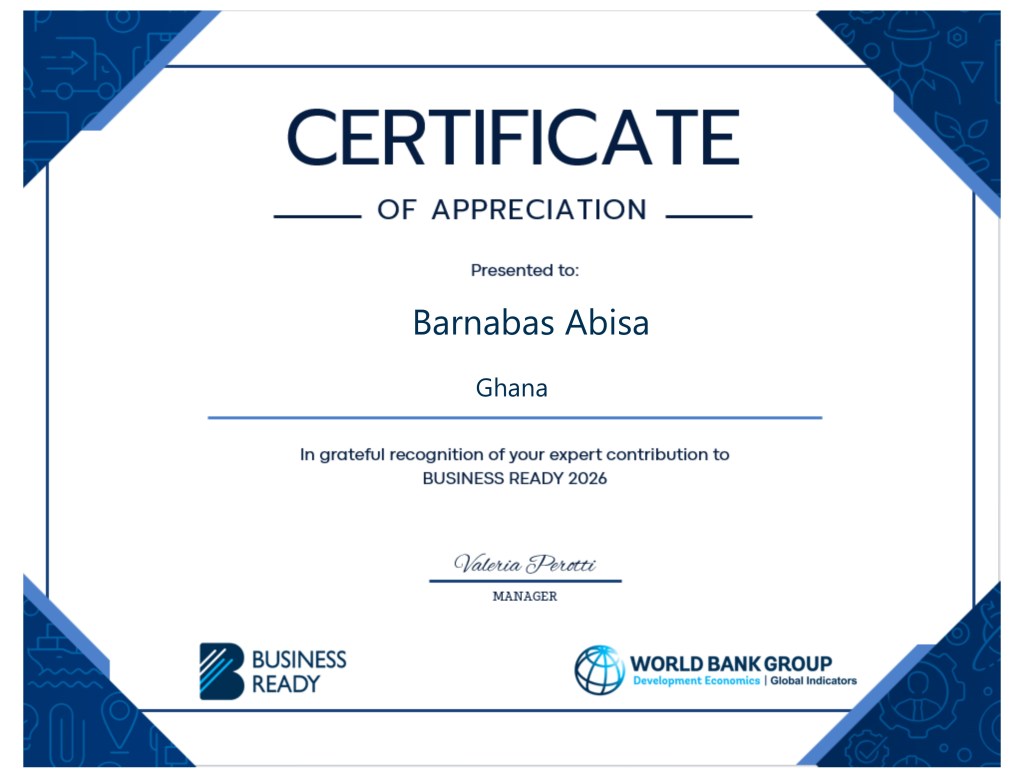
For the past seven years, I have had the privilege of contributing annually to the World Bank Group’s Global Indicators Group research project, formerly known as Doing Business and now known as the Business Ready (B-READY) project.
While working on this year’s questionnaire, I found myself reflecting on the nature of our public institutions and the quality of public service delivery in Ghana. Public institutions exist primarily to serve individuals and businesses. Yet, in many cases, accessing public services remains needlessly difficult, unpredictable, and costly.
Based on my professional experience, three recurring themes stand out: accessibility, predictability, and cost-effectiveness.
1. Accessibility
One of the greatest challenges for businesses and individuals in Ghana is accessing information and services from public institutions.
Many public institutions publish telephone numbers and email addresses, yet it is remarkably difficult to obtain responses through these channels. Calls often go unanswered, some telephone lines are inactive, and emails frequently receive no acknowledgement or response. Consequently, people must visit offices in person to obtain even basic information or routine services.
This challenge is compounded by the fact that some institutions are insufficiently decentralised, with services concentrated in Accra and a few regional capitals. As a result, individuals and businesses located elsewhere incur additional time and cost by travelling long distances simply to access services that could be delivered digitally.
In an era when digitisation, e-governance, and the right to information are actively promoted, it is difficult to understand why basic institutional information and services remain so inaccessible online.
A recent experience illustrates this challenge. A public institution requested that one of our clients provide historical operational records spanning more than ten years within seven days. Although the timeframe posed practical difficulties, the client promptly submitted the information electronically via an official communication channel of the institution.
Subsequently, however, the client’s bank accounts were frozen on the basis that the requested information had allegedly not been submitted. When we sought clarification, we were informed that the documents should have been sent to a specific officer’s personal email address rather than to the institution’s official email address as listed in its correspondence.
Situations like these raise important questions about institutional communication systems and accountability. If official communication channels cannot be trusted, businesses and individuals are left uncertain about how to engage effectively with public institutions.
2. Predictability and Certainty
Another recurring challenge is the uncertainty about timelines for accessing public services.
Businesses thrive on planning and predictability. Unfortunately, services expected to take a day can take several days, and those expected within a week can take a month or longer. Institutional timelines and service standards are often treated as aspirational rather than mandatory. This uncertainty creates significant difficulties for businesses seeking to comply with regulatory requirements, complete transactions, or meet commercial deadlines.
More concerning is the unintended consequence of these delays. When official processes are perceived as slow or unreliable, individuals often feel compelled to seek informal assistance to expedite matters. Over time, this fosters an environment in which middlemen, unofficial facilitators, and corruption flourish.
Indeed, one of the first questions many people ask when dealing with a public institution is not “What is the process?” but rather “Who do I know there who can help?”
This reality undermines confidence in public institutions and weakens the principle that everyone should receive equal treatment under transparent procedures.
3. Cost-Effectiveness
Public service delivery must also be economical.
While most public institutions have officially prescribed fees and charges, many businesses and individuals believe that paying these fees alone is often insufficient to obtain timely service. Additional unofficial costs, whether direct or indirect, frequently arise during the process. As a result, routine services become significantly more expensive than intended, imposing an unnecessary burden on businesses and individuals.
More importantly, some public institutions appear to approach businesses primarily from an enforcement perspective rather than as partners in national economic development. Effective regulation is necessary, but it should facilitate compliance and growth, not create avoidable obstacles.
Businesses generate employment, create value, and contribute to tax revenue. Public institutions should therefore be structured to support lawful enterprise while ensuring appropriate oversight and accountability.
Looking Ahead
The enactment of the Ghana Investment Authority Act, 2026 (Act 1173) and the transformation of the Ghana Investment Promotion Centre into an Authority demonstrate Ghana’s ambition to attract greater foreign direct investment and to position itself as one of Africa’s most attractive investment destinations. However, legislation alone cannot achieve investment promotion.
To become truly business-ready, Ghana must ensure that its public institutions are:
- Accessible;
- Predictable; and
- Cost-effective.
Investors, whether local or foreign, are attracted not only by economic opportunities but also by efficient institutions, reliable processes, and responsive public services.
If we improve these fundamentals, we will strengthen investor confidence, enhance the ease of doing business, and accelerate economic growth. If we do not, we risk losing investment opportunities to competing jurisdictions that offer a more efficient, business-friendly environment.
The question, therefore, is not whether Ghana has the potential to become a leading investment destination in Africa. Rather, the question is whether our public institutions are evolving quickly enough to support that ambition.


Great breakdown. My only hesitation is hoping the 2026 Act actually has teeth… legislation loves to promise “business-ready” environments, but middle-management culture is notoriously hard to legislate out of existence.
LikeLike